Share the idea?

/
Electrical Monitoring Devices
Process
/
HEMS Connectivity Guide: Protocols, Devices & Integration for Smart Home Pros
HEMS Connectivity Guide: Protocols, Devices & Integration for Smart Home Pros
If you’re working with smart home systems or building custom energy management solutions, you’ve probably noticed that energy devices speak different languages than traditional smart home gadgets.
This guide explains:
What HEMS is and why it’s different from regular smart home automation
Which communication protocols are used in real-world energy scenarios
When you need a hub and when you don’t
How to integrate energy devices with your existing smart home setup
What is HEMS and Why Should You Care?
Home Energy Management System (HEMS) is the layer of your smart home that deals with energy—solar panels, batteries, EV chargers, heat pumps, and power monitoring.
HEMS vs. Traditional Smart Home
Traditional Smart Home | HEMS |
|---|---|
Focus: Comfort & convenience | Focus: Energy optimization |
Devices: Lights, sensors, locks, etc | Devices: Solar, batteries, EV chargers, etc. |
Protocols: Zigbee, BLE, MQTT, etc. | Protocols: Modbus, Zigbee, MQTT, EEBUS, OpenADR etc. |
Control: Hub/Cloud-dependent | Control: Local-first, real-time |
Why the difference? Energy devices need:
Real-time response (e.g 1-2 seconds for export limiting)
High reliability (can’t afford cloud outages or network delays)
Bidirectional control (read data AND send commands)
Industrial-grade protocols (Modbus, Zigbee, not just Wi-Fi APIs)
Why HEMS is Growing Fast ?
You’re seeing more HEMS projects because:
Balcony/Residential Solar + batteries are increasingly popular
EV charging needs dynamic load balancing to prevent circuit overload
Time-of-Use (TOU) pricing makes energy timing profitable
Demand Response (DR) programs pay you to reduce consumption during peak hours
Home energy monitoring is easier than ever with affordable smart meters
HEMS Scenarios and Communication Protocols
Here’s what protocols are actually used in real-world residential energy setups:
Scenario | Popular Communication Protocols | Notes |
|---|---|---|
1. Balcony PV and ESS with Export Limiting | Modbus TCP (Wi-Fi); UDP Broadcasting (Wi-Fi) | Fast local control between smart meters and micro-inverters/ESS via Wi-Fi |
2. Residential PV and ESS with Export Limiting | Modbus RTU (RS-485) | Fast local control between smart meters and inverters/ESS via RS-485 wiring |
3. EV Charging with Dynamic Load Balancing (DLB) | Modbus RTU (RS-485); OCPP; Modbus TCP (Wi-Fi); | Modbus for real-time load balancing with meters; OCPP for backend/cloud management and aggregator communication |
4. Home Power Monitoring and AI-Enabled Energy Saving | Zigbee, MQTT (Wi-Fi/Ethernet) | Smart meters, sub-metering devices, and smart plugs for monitoring and automation |
5. Smart Electrical Devices and Panels for Enhanced Safety | Modbus RTU, Zigbee, MQTT(Wi-Fi/Ethernet) | Smart breakers, RCDs, contactors, and load controllers for real-time protection and control |
6. Dynamic Control of Heat Pumps, Water Heaters, and High-Load Appliances | Zigbee, Modbus RTU (RS-485), Modbus TCP/UDP (Wi-Fi) | KNX and EEBUS are also used, Matter overe Wi-Fi/Thread is emerging |
7. Demand Response (DR) / Virtual Power Plant (VPP) Participation | OpenADR, MQTT (Wi-Fi/Ethernet) | Communication handled via gateways, cloud platforms, or aggregators—not direct device-to-utility |
Protocol Quick Reference
Modbus RTU (RS-485): Wired serial protocol, rock-solid for industrial devices (inverters, meters, breakers)
Modbus TCP (Wi-Fi/Ethernet): Modbus TCP running on Wi-Fi/Ethernet, used when devices have network connectivity
UDP Broadcasting (Wi-Fi): Lightweight protocol for real-time data broadcasting in local networks
OCPP (Open Charge Point Protocol): Standard for EV chargers, enables vendor-neutral communication
MQTT: Widely used Lightweight pub/sub messaging protocol running over TCP/IP. Energy devices connect to MQTT brokers (local or cloud-based) via Wi-Fi/Ethernet.
Zigbee: Smart home protocol using mesh networking, used for monitoring and automation. It is also widely used by industrial products – such as cicuit breakers and energy meters
OpenADR: Utility-to-device protocol for demand response programs, enables communication between utilities/aggregators and home energy systems via gateways
Matter (Thread/Wi-Fi): Emerging smart home standard for interoperability across brands. Supports both Thread (low-power mesh) and Wi-Fi. Expected to play a larger role in HEMS monitoring and automation. Backed by Apple, Google, Amazon, and others.
Real-World Integration Examples
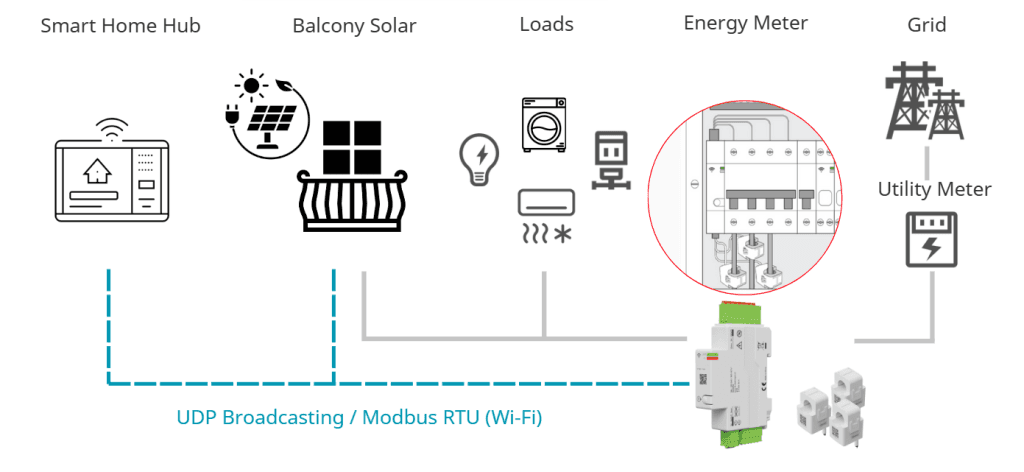
Example 1: Balcony Solar with Export Limiting (No Hub Needed)
Your Setup:
1600W balcony PV system
Bituo Technik SDM01 smart meter with CT clamps on main panel
Smart home system for monitoring
How It Works:
SDM01 measures grid import/export in real-time and broadcasts power data via UDP
Inverter receives power data broadcasted by SDM01 in LAN and adjusts output autonomously
Result: Zero export to grid (required in some EU countries)
Smart home system reads SDM01 via Modbus TCP for dashboards and logging
Protocols Used: UDP Broadcasting (primary control), Modbus TCP (backup control & monitoring)
Hub Required: ❌ No — inverter handles logic autonomously
Example 2: Whole-Home Energy Optimization (Hub Required)
Your Setup:
10kW rooftop solar + 15kWh battery system
11kW EV charger
Heat pump with SG Ready interface
Time-of-Use electricity tariff (cheap at night, expensive during day)
How It Works:
HEMS hub (home automation system with custom automations, or commercial controller) reads TOU schedule
Charges battery at night when electricity is cheap
Limits EV charging during peak pricing hours
Activates heat pump when solar production is high
Sends aggregated data to VPP operator via OpenADR (if participating in demand response)
Protocols Used: Modbus TCP (solar/battery), OCPP (EV), MQTT (coordination), OpenADR (VPP)
Do You Really Need a HEMS Hub?
Short answer: Not always. Many scenarios work with direct device-to-device communication.
When You DON’T Need a Hub ❌
✅ Export Limiting — Inverter reads meter via Modbus, adjusts output autonomously
✅ EV Dynamic Load Balancing — EVSE reads meter via Modbus, adjusts charging current
✅ Panel Monitoring — Smart meter logs data locally or sends to home automation system via Zigbee/MQTT
When You DO Need a Hub ✅
⚠️ Load Shedding — Requires priority logic to determine which loads to disconnect first
⚠️ Time-of-Use (TOU) Optimization — Requires scheduling logic based on electricity pricing
⚠️ Demand Response (DR) — Requires receiving and acting on utility signals (OpenADR)
⚠️ Virtual Power Plant (VPP) — Requires aggregator coordination
⚠️ Multi-Device Coordination — Requires central decision-making (e.g., prioritize EV charging when solar surplus exists, otherwise use battery)
⚠️ Grid Data Exchange — Requires secure communication with external systems (utilities, aggregators)
What Can Act as a Hub:
Smart Home Hub with HEMS Add-ons/Integrations (Home Assistant, Homey, etc.)
Dedicated HEMS Controller (Gridx gridbox, Enjoyelec Air, etc.)
Relationship Between HEMS and Smart Home Systems
HEMS can be viewed as the “energy subsystem” within a smart home—similar to lighting, HVAC, or security—but with the flexibility to operate independently.
HEMS devices can:
Run locally without a smart home hub (device-to-device communication)
Connect upward to smart home hub or cloud for visualization and automation
Operate in hybrid mode (local control + hub/cloud coordination)
For users who value ease of use, integrating HEMS devices into a unified smart home app provides an excellent user experience. Platforms like Homey and Tuya that include HEMS features are popular for this reason. Open smart home systems such as Home Assistant are also rapidly expanding their HEMS-related integrations.
Key Terminology
Term | Definition |
|---|---|
DLB | Dynamic Load Balancing — Real-time adjustment of EV charging based on available circuit capacity |
ESS | Energy Storage System — Battery for storing solar energy or grid power |
Export Limiting | Preventing excess solar power from flowing back to the grid (zero export) |
OCPP | Open Charge Point Protocol — Standard for EV charger communication |
TOU | Time-of-Use — Electricity pricing that varies by time of day |
VPP | Virtual Power Plant — Network of distributed energy resources coordinated as one controllable plant |
OpenADR | Open Automated Demand Response — Protocol for utility-to-device communication |
SunSpec | Modbus-based solar inverter standard for cross-brand compatibility |
CT Clamp | Current Transformer — Non-invasive sensor for measuring electrical current |
DIN Rail | Standard mounting rail for electrical equipment in distribution panels |
Conclusion: What You Should Remember
✅ HEMS is different from traditional smart home automation — it’s about real-time energy monitoring and control, not just comfort
✅ Protocols matter — Modbus, Zigbee, and MQTT are the workhorses of HEMS, Matter over WiFi/Thread is emerging
✅ Hubs are optional for basic use cases (export limiting, DLB, monitoring)— direct device-to-device communication often suffices.
✅ Hubs are required for advanced use cases (TOU optimization, DR, VPP, load shedding)
The Future of HEMS Communication Protocols
The industry is converging on protocols that are:
🔓 Open & Non-Proprietary
Open standards like Modbus, MQTT, OCPP, OpenADR, and Matter enable vendor-neutral integration. No lock-in, easier to understand, faster adoption, and lower long-term costs.
⚡ Fast & Reliable
Sub-second response times for safety-critical functions (export limiting, overload protection). Deterministic communication for real-time control. Resilient to network failures with local fallback mechanisms.
🔒 Secure by Design
End-to-end encryption (TLS/DTLS), authentication, and authorization. Protection against cyber threats as HEMS devices become grid-interactive. Compliance with emerging cybersecurity standards (IEC 62443, NIST guidelines).
🔗 Interoperable Across Brands
Seamless integration between inverters, batteries, EV chargers, heat pumps, and smart meters from different manufacturers. Standardized data models ensure plug-and-play compatibility. Future-proof for grid services and energy markets.
💡 Why This Matters:
These solutions integrate easily today and are ready for grid interaction tomorrow. As residential energy systems evolve from passive consumers to active grid participants, choosing the right protocols now ensures scalability, flexibility, and compliance with future regulations.
Who This Article Is For:
PV installers, EV charging installers, and energy monitoring specialists
Smart home DIYers building or optimizing residential energy systems
System integrators expanding into residential energy solutions