Share the idea?

/
Electrical Measurement Components
Process
/
Is RCD Type B Better Than RCD Type A + RDC-DD at EV Charging?
Is RCD Type B Better Than RCD Type A + RDC-DD at EV Charging?
By
IEC61851-1: 2017 and IEC60364-7-222:2018 specify the protective measures against the residual current for Mode-3 EV AC charging systems as following
Option 1: RCD Type B complying with IEC62423 or IEC60947-2
Option 2: RCD Type A complying with IEC61008-1, IEC61009-1, or IEC60947-2 and RDC-DD complying with IEC62955
People might ask what the difference between the two protective measures is. The following table shows the protective difference between Option 1 and Option 2
Protective Measure | Fault current detected | Protective Difference |
Option 1: RCD Type B (I∆n = 30mA) |
|
|
Option 2: RCD Type A (I∆n = 30mA) and RDC-DD (I∆dc = 6mA) |
|
|
The tripping range of Type B 30mA RCD for smooth direct residual current is between 15mA and 60mA, while the tripping range of RDC-DD for smooth direct residual current is between 3mA and 6mA. The following diagram shows a type-B RCD of 30 mA installed at the final power distribution system. This type B RCD of 30mA does not trip in the occur of 6mA ~ 15 mA DC fault current – such as the DC fault current brought by OBC insulation fault. However, the DC fault current within 6mA ~ 15 mA can impair the function of the upstream type AC/A RCD.
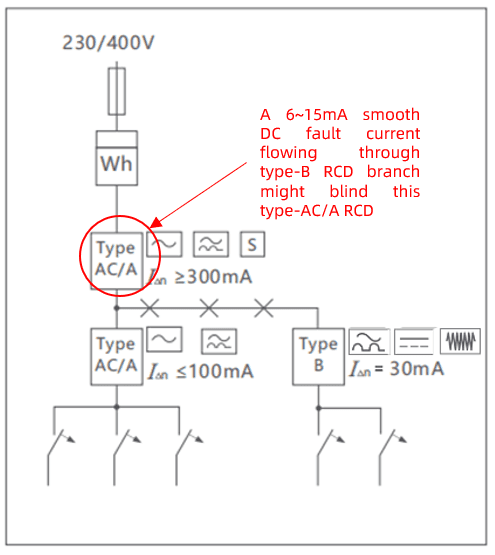
In order to erase the risks, the following installation approaches for Type-B RCD installation are usually used.
Approach A: Replace the upstream type-AC/A RCD with a type-B RCD
Approach B: Change the in-coming power supply of the type-B RCD from the out-going terminal of the upstream type-AC/A RCD to the in-coming terminal of the upstream type-AC/A RCD
For home charging applications, neither Approach A nor Approach B is a good solution from the perspective of product cost and installation convenience. Therefore, there is a clear trend of using the combination of RCD Type A and RDC-DD for residual current protection for home EV charging.

