Share the idea?

Type EV RCD and Type B RCD for EV charger
Han Xiang
💡 Author's Note: This article focuses primarily on DIN Rail-mounted modular RCDs used for electrical installations and distribution boards. If you are an EV charger manufacturer looking for PCBA-level built-in RCD solutions, please check out our residual current sensor page.
The IEC 61851-1 standard specifies the required residual current protection measures for Mode-3 EVSE as follows:
Option 1: RCD Type B
Option 2: RCD Type A, combined with appropriate equipment to disconnect the supply in case of DC fault currents exceeding 6mA.
Both options require smooth DC residual currents protection in addition to sinusoidal AC and pulsating DC current protection, which can be further implemented via built-in RCD approach at EV chargers or standalone RCD inside/outside. These two typical configurations of Type EV/B RCD are illustrated in the following diagram:
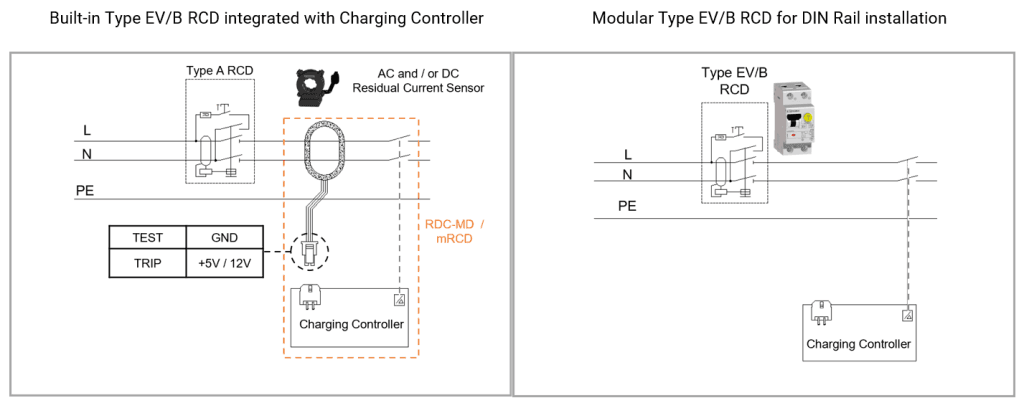
Typical configurations of Type EV/B RCD used for Mode-3 EVSE
This informative piece is tailored for electricians, installers, and DIY enthusiasts, offering valuable and suitable insights and guidance in making the right selection of DIN Rail-mounted EV/B RCDs with a modular design.
What are Type EV RCD and Type B RCD? What sets them apart?
Type EV RCD (RDC-PD) and Type B RCDs serve the crucial purpose of disconnecting power supply during residual current faults, as defined in IEC 62955 for Type EV RCD and IEC 62423/IEC60947-2 for Type B RCDs.
Both Type EV RCD (RDC-PD) and Type B RCD can detect Sinusoidal AC and Pulsating DC residual currents, tripping to switch off the power supply when faults occur. However, their key differences, especially for chargers for electric vehicles, lie in:
Rated DC residual operating current I∆dc and Rated DC residual non-operating current IΔndc
Whether to provide protection against composite residual currents* with frequencies up to 1000 Hz
* Such protection is not required for AC EV charging applications, as this type of residual current form does not exist when an EV charger directly feeds a well-designed onboard charger in electric vehicles.
Refer to the following table for a detailed comparison:
RCDs | Standard | Fault Currents Detected |
|---|---|---|
Type EV RCD(RDC-PD) | • IEC 62955 | • Sinusoidal AC residual current |
Type B RCD | • RCCB/RCBO: IEC 62423 | • Sinusoidal AC residual current |
To gain a better understanding, you can view the fault current waveforms in this video.
Shall I Use voltage-dependent or voltage-independent type EV / B RCDs?
The terms “voltage-dependent” and “voltage-independent” refer to the architecture of a type EV/B RCD used to detect sinusoidal AC and pulsating DC residual currents. Some may use “electronic” and “electromagnetic” respectively for these terms.
An RCD independent of supply voltage operates with a core part of the trip relay featuring a permanent magnet, requiring no auxiliary energy and utilizing residual current from the output winding of the summation current transformer. On the other hand, a voltage-dependent RCD amplifies the voltage from the output winding using an electronic amplifier to activate a robust trip relay.
It’s important to note that both “voltage-dependent” and “voltage-independent” can be applied to the Type-A part of a type EV/B RCD, which provides protection against sinusoidal AC residual currents and pulsating DC residual currents. To detect DC smooth current, an electronic circuit using “fluxgate” technologies is widely used.
While the international standard IEC 60364 considers both types equivalent, local regulations and laws should be considered when choosing between “voltage-dependent” and “voltage-independent” Type EV/B RCDs. For example, both types are allowed in China and most Asian countries, while only the “voltage-independent” type is permitted in most European countries like Germany, France and Italy.
Installation locations of Type EV RCD and Type B RCD
RCDs for EV charging are mostly installed next to the EV charger, at the incoming line or the outgoing circuit of a distribution board.

Installation locations of a Type EV/B RCD
Installation locations | Recommended devices | Comments |
Incoming circuit of a distribution board | Type B RCD | We recommend using Type B RCDs to prevent nuisance tripping. In Germany, France, and many other EU countries, a Type A RCCB installed at the incoming circuit of the indoor distribution board can be replaced with a Type B RCCB. |
Outgoing(branch) circuit of a distribution board | Type EV RCD | It is necessary to derive the power supply of the Type B RCD feeding EV charger circuit upstream of any non-Type B RCDs. If an upstream RCD is required, it is crucial to use a Type B RCD for this one as well.
Therefore, it is cost-effective and simple to install a type EV RCD. When a dedicated branch circuit feeds the EV charger, the voltage-dependent Type EV RCBO (RCBO=MCB+RCCB) is a good residual current protection solution for AC EV charging in Asia. |
Next to an EV charger | Type EV RCD | A water-proof distribution board containing a Type EV RCD is installed next to the EV charger. Considering the location at the outgoing (branch) circuit of a distribution board, it is not recommended to use Type B RCD for similar reasons. |
Avoid Type EV/B RCD damages from insulation resistance test
Both type EV and Type B RCDs contain an electronic board that draws power from the live and neutral conductors. To safeguard against electronic board failures during insulation tests, it’s vital to disconnect the live and neutral wires from the type EV and B RCDs before the test.
While some manufacturers suggest setting the toggle of the type EV/B RCDs to the OFF position as sufficient, we highly recommend unplugging the terminals to further reduce the risk of product damage due to potential testing errors. Prioritizing safety ensures a reliable testing process.
Why is the regular test of Type EV/B RCDs necessary for EV chargers?
Type EV/B RCD plays a critical role in preventing electrocution and safeguarding lives. A faulty RCD can pose severe risks of injury or even fatality. This is especially crucial for high-power equipment like electric vehicle chargers, which are exposed to challenging outdoor conditions such as rain and heat. Given their usage, electric vehicle chargers are more susceptible to ground faults compared to typical home appliances. Prioritizing the reliability and functionality of Type EV/B RCDs is paramount for ensuring the utmost safety.
To ensure the proper functioning of Type EV/B RCD, regular testing is essential. There are two testing methods for the type EV/B RCD available:
Testing with internally generated residual current: Simply press and release the ‘test’ button on the device to internally generate a residual current for self-testing.
Testing with externally generated residual current: Use a portable RCD tester capable of generating Sinusoidal AC and Smooth DC currents to assess the type EV/B RCD’s functionality.
For optimal safety, we advise testing each type of EV/B RCD monthly to maintain its reliability and effectiveness.
Empowering RCD Manufacturers with Bituo Technik
The core of reliable EV charging protection lies in advanced detection technology . At Bituo Technik, we specialize in providing high-performance electronic systems for Type B RCBO and RCCB manufacturers (OEMs).
Powered by our proven fluxgate current sensing technology, we offer both Single (Sole VD) and Hybrid (VI + VD) detection systems. By integrating our ready-to-use solutions into your circuit breaker platforms, you can ensure IEC compliance, bypass heavy R&D investments, and shorten your time-to-market to just 6-12 months.
📩 [Contact us] for tailored integration support.