Share the idea?

/
Electrical Measurement Components
Process
/
Why Built-in RDC-DDs are the Preferred Choice for EV Charging over Type B RCDs
Why Built-in RDC-DDs are the Preferred Choice for EV Charging over Type B RCDs
Zhou Gang | Bituo Technik
IEC 61851-1:2017 requires the detection of smooth DC leakage current above 6 mA for AC EV charging to ensure electrical protection. Both Type B RCDs and RDC-DDs can be used for this purpose, individually complying with IEC 62423 / IEC 60947-2 and IEC 62955. In a related blog post, we explored where the smooth DC leakage current comes from.
However, since IEC 62955:2018 came into effect, built-in RDC-DDs have become the dominant choice. This article breaks down the technical and commercial reasons behind this industry shift.
What are Built-in RDC-DDs?
RDC-DD stands for Residual Direct Current Detecting Device, and it is used for Mode 3 charging of electric vehicles. An RDC-DD compliant with IEC 62955:2018 can detect smooth DC residual currents above 6 mA and ensure that the Type A/F RCDs’ proper functionality is not impaired. The RDC-DD disconnects the power supply to the EV when it detects a smooth residual direct current equal to or above 6 mA.
There are two types of RDC-DDs in practical applications: independent RDC-DDs and built-in RDC-DDs. An independent RDC-DD can disconnect all live conductors in case of DC leakage currents, while a built-in RDC-DD’s function is provided by coordinated activities among the DC leakage current sensor, the EV charging controller, and the relays/contactors.
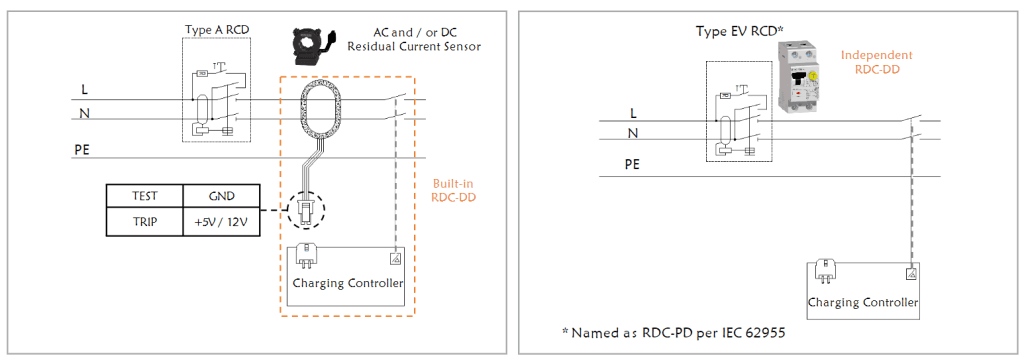
Built-in RDC-DD and Independent RDC-DD
What is a Type B RCD?
Type B RCDs, such as Type B RCBO and Type B RCCB, are mainly used for protection against sinusoidal AC residual current, pulsating DC residual current, composite residual currents with frequencies up to 1000 Hz, and smooth DC direct currents. They can be installed in the circuit feeding the EV charger to detect smooth DC leakage current.
Factors Influencing the Selection: Built-in RDC-DD vs. Type B RCD
Our experienced experts believe that three major factors drive the widespread adoption of built-in RDC-DDs over Type B RCDs:
Competition: Both solutions are safe and standard-compliant. However, Type B RCDs are significantly more expensive. For EV charger manufacturers, a Type B RCD solution costs at least three times as much as a built-in RDC-DD.
Maintenance: It is acceptable to remotely reset the control device after the DC smooth current disappears. A built-in RDC-DD—consisting of a DC leakage sensor, charging controller, and relays—facilitates this remote re-closing function. Achieving this with a Type B RCD is difficult due to its combined AC and DC leakage tripping mechanism.
Installation: As discussed in our previous post, if a Type AC/A RCD is installed upstream, adding a Type B RCD requires electricians to change the incoming power supply of the Type B RCD from the outgoing terminal of the upstream Type AC/A RCD to its incoming terminal. Alternatively, the upstream RCD must be replaced entirely with a Type B RCD. A built-in RDC-DD eliminates this extra rewiring and investment.
Bituo’s Sensors for Built-in RDC-DD Design
Bituo offers a comprehensive range of AC/DC leakage current sensors that facilitate built-in RDC-DD design in AC EV chargers, providing a reliable and cost-effective protection solution. The BRCS01/02 series has a proven track record in IEC markets, while the upcoming BRCS01C will deliver enhanced performance with both 5V and 12V interface options.

Conclusion
While both built-in RDC-DDs and Type B RCDs effectively detect smooth DC leakage current, built-in RDC-DDs dominate EV charging applications due to their superior cost-efficiency, simplified maintenance, and streamlined installation process.
If you’re interested in learning more about residual current monitoring and protection technologies, or need assistance with the right solution for your specific needs, feel free to contact us anytime. Our experienced team is always ready to help you find the best solution for your EV charging protection needs.